
Gemelle Sorelle: Finding family and friendship in Perugia
Written by 2026 October Scholar Shandra Sgobba
I enter my flat in Perugia, open the shutters, and gaze toward rolling hills and rooftops. A deep sense of humility washes over me, and I take a picture to remember the moment. My Italian language classes begin tomorrow, and I feel excited and hopeful for what lies ahead. I say a prayer of thanks to the friends and family who have encouraged and supported me, and reflect on the journey that has brought me here.
Last year, after speaking with recent scholars at Cinema Italian Style, I began considering an application for the scholarship. The graduates had just returned from Perugia, and spoke enthusiastically about their experiences, sharing photographs and Baci chocolates. Although I felt insecure about my beginner-level Italian, they encouraged me to apply. I knew I needed something to reignite my motivation to study, so I decided to take a chance.

I grew up in an Italian-American household, but the only words I remember from childhood are “Mangia, mangia!”— delivered emphatically. Then I began working as a waitress in Italian restaurants, where I developed an appreciation for the dishes and wines from the varied regions. I was drawn to the warmth and vitality of Italian culture and dreamed of visiting Italy one day to discover the roots of my father's family, the Sgobbas.
When my nonno passed away, I inherited a copy of his memoirs. He was raised by immigrant parents and grandparents and had a difficult childhood, but the stories he chose to share were about working in the vegetable garden, making wine in the cellar, and running numbers for the local mafia. Intrigued, I travelled to the town outside Boston where he grew up, but there was little to see besides a bowling alley and a pool hall.
Then my sister Joy began researching our ancestry online. She uncovered the names of distant relatives and the towns where they had lived. She was unable to travel at the time, so in 2022, I packed a suitcase, including a T-shirt emblazoned with SGOBBA across the front, and flew to southern Italy by myself.
While renting a bicycle in Puglia, something serendipitous happened. A woman named Chiara noticed my Seattle address and unusual surname and contacted me by email. She told me she appreciated Seattle's music scene and that her nonna had the same surname as mine. As I was getting lost cycling through olive groves something magical was taking shape. We wrote to each other a few times, including our families names and birthdates, trying to find connected limbs in our ancestral trees. I vowed to return the following year so we could meet..
It was raining hard when Chiara picked me up at the train station. She introduced me to her closest friends and family and explained that they had all been working hard to uncover clues about my relatives. Thanks to their persistence and a little luck, I connected with some distant cousins, while Chiara translated and filmed our gathering.
Sadly, we discovered that Chiara and I weren't related by blood. But then she and her family did something extraordinary. They decided that although we weren't technically family, we belonged together so they adopted me. I sat at their table for four long hours, surrounded by animated conversation and seemingly endless amounts of food. I longed to understand their stories, follow their conversations, and laugh at their jokes. I wanted to be part of it all, rather than simply smile and hope I had understood correctly. And that is where my desire to learn Italian really took root.
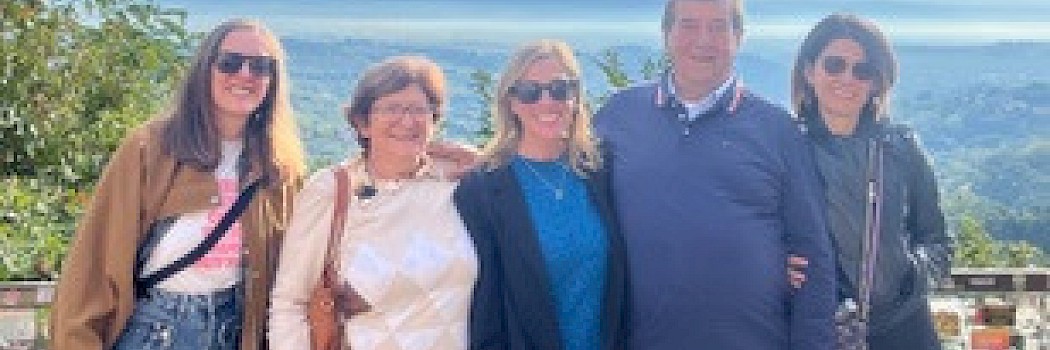
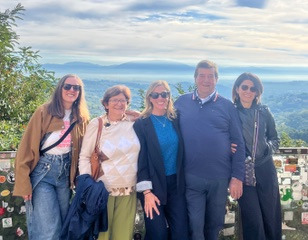
I return to visit Chiara and her family every year, and they patiently cheer me on as my Italian improves. When they learned I would be studying at the University for Foreigners in Perugia, they planned a trip to encourage me.( They took three trains to get there without a single complaint!) I proudly showed them the Sister Orca statue, sharing a little piece of my hometown with them. I hope that one day they will visit Seattle, and I can return their hospitality.
Soon after arriving in Perugia, I was invited to a welcome party at the home of Marialucia. There, I met members of SPSCA from Perugia and was treated to an exquisite aperitivo of homemade bread and dolci.The table she set was a work of art and the food was remarkable! She made us feel at ease, asking about our interests and experiences and genuinely caring about what we had to say. I was particularly proud that I could converse in Italian. Several other members arrived bearing gifts, and my biggest regret so far is that I neglected to bring her a gift. (So, future scholars reading this: don't forget to bring one!) Then, MariaLucia took us up to her rooftop terrace, where she lit two candles representing the relationship between Seattle and Perugia. She used the word gemelle—twins—instead of sorelle, meaning sisters, to describe the relationship between our cities. The distinction intrigued me. Twins share a special bond, but sisters can come together through circumstance, affection, and choice. Perhaps both words capture something essential about the relationship between two places that have found a special bond across an ocean.

I love taking classes in an ancient palazzo that has been converted into a university. I am meeting students from all over the world, and wish I had more time to spend with them. I want to ask questions, hear their stories, and understand what has inspired each of them to study Italian.
We take advantage of the pausa between classes to squeeze in little conversations, but I am realizing how difficult it is to connect when you have limited language skills. I try to get creative, using expressions and hand gestures to explain myself, but sometimes I feel frustrated. I am the only American in my class, and I feel a certain responsibility for how my classmates perceive me and my country. I want to communicate well, to be curious and open, and to represent myself thoughtfully. Yet I am constantly reminded that I am a beginner, and there is so much I cannot yet express.
I have made friends with a young priest from Zambia, a massage therapist from Venezuela, and a Scottish retiree. Getting to know them is expanding my understanding of the world and my place in it. We are all here to learn, but have arrived with different experiences and expectations. Communicating is about more than grammar and vocabulary. It is about making an effort to understand another person, even when you don't understand the words they are speaking. One day, several students from Kuwait prepared a traditional breakfast for our class. They brought in two kinds of coffee: One was stronger, from the north, while the other was milder, with milk added, from the south. It was such a thoughtful gesture, and a reminder of how much we can learn from each other through the simplest acts of generosity.

People I meet around town seem generous and helpful, perhaps recognizing that many of us are students trying our best to learn Italian.I love sitting on the steps in front of the Fontana Maggiore, listening and watching people pass by. My favorite time of day is sunrise. I try to study, but I am continually distracted by the changing colors unfolding before my eyes. Each time I walk beneath the ancient Etruscan arches, I am awestruck by the layers of history surrounding me. I have taken yoga classes in Italian, walked through underground tunnels, visited museums, and sampled many cafés and restaurants. I have also ventured beyond Perugia to explore nearby towns such as Spoleto and Todi, and the beautiful shores of Lago Trasimeno.
There is so much to discover, and I am learning to appreciate the small moments as much as the grand ones: the first light over the rooftops, a friendly exchange in Italian, a meal shared with new friends, or the satisfaction of understanding a conversation that might once have passed me by. Of course, there are moments when I wish I could express myself more easily. I want to know more about the people I meet and to hear the stories behind their lives. But perhaps the struggle itself is part of the experience. Every conversation is an opportunity to practise, to listen more carefully, and to become a little more confident.

When I visited the Sister Orca statue, I was in awe. She stands so regal and proud and I wonder if people understand how majestic and expansive whales and the Puget Sound are? I pick up cigarette butts and litter near her and feel a sense of kinship with her presence. Seeing her in Perugia brings my two worlds together. I had travelled to Italy to explore my family's history, but I was discovering connections that went far beyond genealogy. I met Chiara by chance, and she and her family chose to adopt me, even when our family trees revealed no direct connection. Their generosity opened a door to a world I had long wanted to understand. It also gave me a reason to keep learning Italian: not simply to speak another language, but to participate more fully in the lives of people I love.
In Perugia, I am discovering another kind of sisterhood through the people who have welcomed me into their homes and community. I feel fortunate to be studying in a twin city, surrounded by people who have given me encouragement and kindness. I find myself wondering how I can give back. Perhaps it begins with small things: welcoming a visitor from another country, sharing a meal, or helping someone else feel at home in an unfamiliar place. Maybe it means carrying the spirit of Perugia back to Seattle and continuing to build connections between our communities.
As I reflect on my journey, I am reminded of a sentiment often attributed to Chief Seattle: that the Earth does not belong to us; rather, we belong to the Earth, and all things are connected. Perhaps belonging to a family, or a city isn’t inherited. Sometimes it is a feeling or a chance discovery. Maybe it is something we build, one conversation, one shared meal, and one act of kindness at a time. And sometimes, if we are lucky, we find ourselves surrounded by sisters in places we never expected.